Start with a surface list
List the places where the customer meets the identity: a sewn brand label, hangtag, mailer, product page and first social post. Give each surface one job. A sewn label may identify the brand; a hangtag may explain the collection; the product page must help the buyer understand the actual garment. Copying the same hero artwork onto every surface leaves those tasks unresolved.
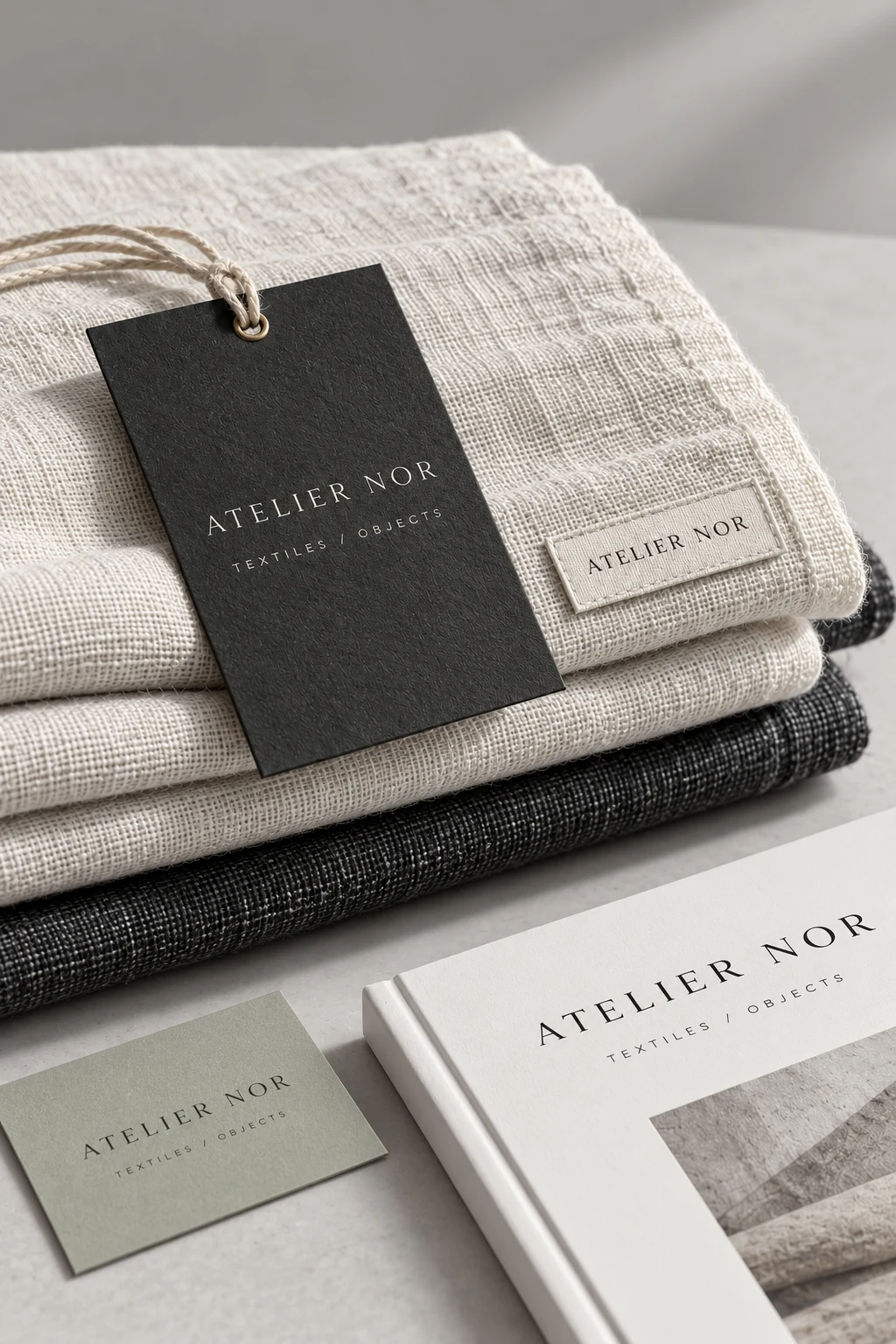
ATELIER NOR is a fictional textile and lifestyle concept. Its imagery is an art-directed, AI-assisted study, not a photograph of a manufactured collection. We use it to discuss hierarchy and materials as visual references, without claiming a particular fabric composition or production method.
Use a handoff matrix
| Surface | Design task | Information to obtain before production |
|---|---|---|
| Sewn brand label | Keep the mark recognizable at the actual size | Finished size, fold or seam areas, supplier template and minimum detail limits |
| Hangtag | Separate the brand, collection and product identifier | Attachment position, stock, finish, barcode and approved product copy |
| Packaging | Connect the unboxing with the same identity | Supplier dieline, print process and actual dimensions |
| Product page | Show the correct garment and variant | Original photos, verified product specifications and current availability |
| Social launch | Communicate one product or collection fact | Approved photo, accurate caption and working destination |
Test the mark at the size it will be used
Keep an approved primary signature and a simpler variant where needed. Print a size sample or ask the supplier for a proof instead of assuming the large screen preview represents a woven or printed label. Fine gaps, hairline strokes and small lettering may need a different treatment for the chosen process.
Record the supplier’s requirements in the worksheet. There is no single minimum logo size that this guide can truthfully prescribe for every technique. A screen SVG proves the shape of the artwork; it does not prove that a particular machine, thread or substrate can reproduce it.
Separate brand copy from product information
A tagline can establish tone, but it cannot stand in for fiber, care, origin or other required product information. Have the responsible product owner and supplier confirm the correct wording for the actual garment and destination market. This guide is about organizing design decisions, not deciding legal labeling requirements.
Keep unknown fields visibly unresolved in the internal handoff. Do not infer “organic,” “recycled,” “handmade” or a country of origin from a concept image. If the source document changes, revise the tag, product page and launch caption together.
Define how the collection is photographed
Specify a repeatable background, crop, lighting direction and detail sequence. Include the front, back and relevant construction details when they help the buyer. Keep a record of the exact variant shown. Styling images can express a mood, while product-information images must remain accurate.
Use the social branding guide to carry type and color into posts without covering useful garment detail. For the broader system, the guidelines template provides a place for logo, typography and usage rules.
Hand over decisions and unresolved questions
Package the current logo files, font license information, screen color values, supplier template, approved wording and proof references. Keep draft concepts outside the approved folder. Write down who still needs to confirm the physical specification; an attractive brandbook is not production approval.
Download the clothing identity handoff worksheet
Explore the ATELIER NOR concept, then use the logo file-format guide to choose editable artwork and review copies. Brandfolia’s application exports are sRGB design concepts; a supplier must prepare and approve them for the actual production process.