What belongs in a small business brand kit?
Start with an approved name and logo or wordmark, a small palette with named roles, display and body typography, a short business description and the applications your customers will actually see. A brandbook records the rules; the kit contains the usable files.
For a first launch, select three applications at different sizes. A small label, a phone screen and a presentation cover expose different spacing and readability problems. The number is a practical review choice, not a rule that every business needs exactly three files.
| Business situation | First useful applications | Information to settle |
|---|---|---|
| Independent service business | Contact card, proposal cover, website hero. | Service, audience, contact route and the promise you can support. |
| Online product business | Product label concept, product-page hero, social post. | Product name, variant, accurate photography and approved product facts. |
| Local café or shop | Cup or bag artwork, contact card, social story. | Location, opening information and which details change with each offer. |
Choose a starter, an existing identity or an AI proposal
If you already have a logo, preserve it and make the surrounding rules explicit. If you need a visual starting point, the free starter kits contain placeholder identities you can edit locally. Custom AI proposals are a separate paid-credit workflow with sign-in; public checkout is not open.
Brandfolia’s starter ZIP contains four signature SVGs, 13 application SVGs, brand JSON, palette CSS, fonts and license notes. The template ZIP contains no PDF. Import its JSON into the studio, edit the profile and export the 30-page brandbook when you need a document to share.
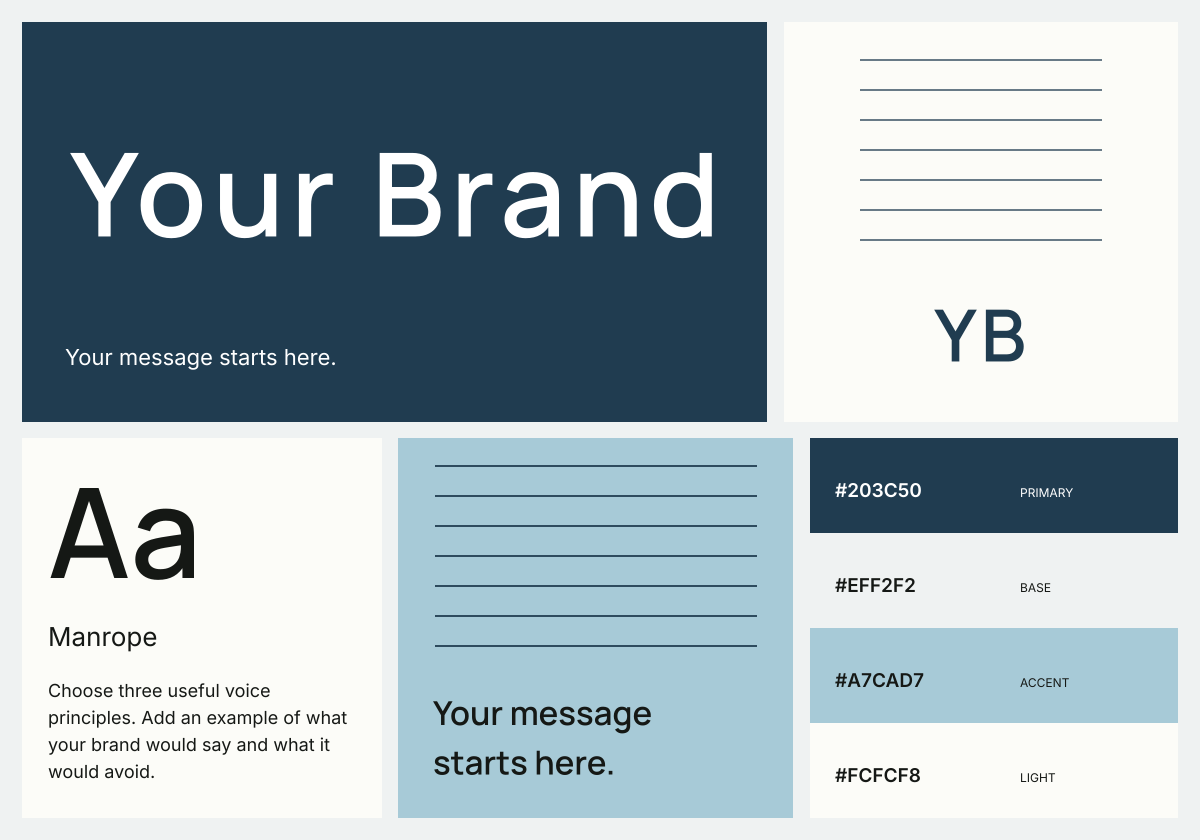
Run a first-launch review
- Replace placeholders: name, tagline, business description and contact details must belong to your business.
- Assign color roles: identify the anchor, background and accent, then check the actual text/background pairs.
- Test real copy: use your longest product or service name and a real address, not short sample text.
- Compare the first applications: check the mark, typography and hierarchy at their intended viewing sizes.
- Keep one approved version: save the source profile, exported files, font licenses and unresolved production notes together.
A simple handoff folder
Separate approved files from experiments. Record who can update the identity, which version is current and what a printer or developer still needs to confirm. A website hero SVG is design artwork, not a functioning website; a packaging label concept needs supplier specifications before production.
The downloadable launch worksheet records a customer interaction, three priority applications, the owner of each source file and a review action. For a product-specific plan, continue to the skincare guide or coffee guide.
Make the next version usable
Start with a free editable brand kit, record your rules in the brand guidelines template, then use the handoff checklist to review the matching files.
Starter templates, sample editing and exports are available without an account. Custom AI proposals require an account and paid kit credits; public paid checkout is not open. Check current access and allowances.